Posts

Showing posts with the label culture

Dressing Indian Women : Clothing and Fashion in the Early Twentieth Century.
Image
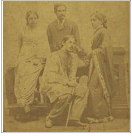
  Clothes veil the body. They are part of a cultural politics by which nations are actively produced. [1] They are a form of social control, a mechanism of inclusion and exclusion, mirroring social hierarchies and moral boundaries. [2]   British imperial presence in India had introduced not only new forms of government, language, education and social etiquette, but also a new set of criteria of civilisation with a new set of clothes to go with it. It was only in the early Twentienth Century India that the nationalist movement begun to perceive cloth and clothing as central symbols in the struggle to define a national identity. Women, as such, emerged as important bearers of this identity.   While the dress of British women who came to live in India were conformed to sartorial conventions of a memsahib, draped clothes (Sari, in this case) were of prime importance in the Indian nationalist discourse. However, many women from elite families began adopting the stitch...
Situating Dalit Women in Grassroot Politics : Channar Revolt and the Struggle for a Dignified Life

Image
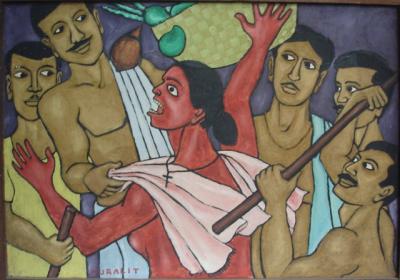
  Abstract : Dalit women in India have had a long history of suppression and of leading lives of routine indignity and humiliation. The ‘Breast Tax’ (Mulakkaram or mula-karam in Malayalam), imposed on the lower caste, Dalit women by the Kingdom of Travancore (in present-day Kerala) if they wanted to cover their breasts in public, was one of the many ways of oppressing them. This indignity on the part of the dominant castes inculcated into one of the most significant Dalit as well as female revolts in history – The Channar Lahala or the Channar revolt (also called the Maru Marakkal Samaram) -   a relentless struggle of the Nadar climber women of Travancore for their right to wear upper-body garments. This historic revolt, made news a few years ago, in the CBSE’s infamous decision (2016) to remove the section titled ‘Caste, Conflict and Dress Change’ from its social science curriculum, by labeling it as “objectionable content”. This amounted to an attempt to erase the history ...

Gandhi Gatha: a discourse everyone needs

Image
As the International Webinar on The Relevance of Mahatma Gandhi in the 21 st Century : Philosophies, Political ideas and Socio-Spiritual Dimensions came to an end on the 5 th and the last day of the Lecture Series on 7 th October, 2020 organised by The Department of History, Kirori Mal College and Internal Quality Assurance Cell (IQAC), the participants shared their knowledge and understanding which was enhanced by the prior lectures. On 7 th October, the platform of the Webinar was thrown open to all the participants for learning through the discourse of debate and discussion. Due to the constraints of the online platform and managing between two different time zones, the organizing committee could not give chance for a discussion that usually follows after a lecture. However, the organizing committee was aware that no clarity could be gained in the field of social sciences without allowing the scholars to discuss and debate and thus on the last day Gandhi Gatha was organized w...

Rekhta- From an Un-cultured language to the language of Elite

Image
As the students of the History Department in third-year are reading about Rekhta as a source to reconstruct Mughal History, they have also come across a reading by Prof. Saifuddin Ahmad- Bas Ke Samjhe Hai Isko Sare Awam: The Emergence of Urdu Literary Culture in North India . Therefore to throw some light on the topic of Rekhta and to acquire more knowledge out of the given readings, the History Department of Kirori Mal College invited Professor Saifuddin Ahmad to speak on the Early Urdu Literary Tradition & the Practice of Rekhta . The lecture was conducted via GoogleMeet platform at 11am on 1 st September, 2020. About the Lecturer : Professor Saifuddin Ahmad is a professor at University of Delhi and he specialises in Medieval Indian History and Culture and History of the Islamic World. He has done his Bachelors and Masters in History from Aligarh Muslim University and completed his M.Phil in History from Jawaharlal Nehru University. Savouring the Past: Food and Taste in In...