Posts

Showing posts with the label patriarchy

Dressing Indian Women : Clothing and Fashion in the Early Twentieth Century.
Image
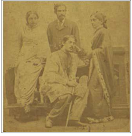
  Clothes veil the body. They are part of a cultural politics by which nations are actively produced. [1] They are a form of social control, a mechanism of inclusion and exclusion, mirroring social hierarchies and moral boundaries. [2]   British imperial presence in India had introduced not only new forms of government, language, education and social etiquette, but also a new set of criteria of civilisation with a new set of clothes to go with it. It was only in the early Twentienth Century India that the nationalist movement begun to perceive cloth and clothing as central symbols in the struggle to define a national identity. Women, as such, emerged as important bearers of this identity.   While the dress of British women who came to live in India were conformed to sartorial conventions of a memsahib, draped clothes (Sari, in this case) were of prime importance in the Indian nationalist discourse. However, many women from elite families began adopting the stitch...
Situating Dalit Women in Grassroot Politics : Channar Revolt and the Struggle for a Dignified Life

Image
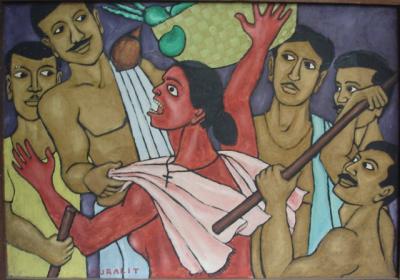
  Abstract : Dalit women in India have had a long history of suppression and of leading lives of routine indignity and humiliation. The ‘Breast Tax’ (Mulakkaram or mula-karam in Malayalam), imposed on the lower caste, Dalit women by the Kingdom of Travancore (in present-day Kerala) if they wanted to cover their breasts in public, was one of the many ways of oppressing them. This indignity on the part of the dominant castes inculcated into one of the most significant Dalit as well as female revolts in history – The Channar Lahala or the Channar revolt (also called the Maru Marakkal Samaram) -   a relentless struggle of the Nadar climber women of Travancore for their right to wear upper-body garments. This historic revolt, made news a few years ago, in the CBSE’s infamous decision (2016) to remove the section titled ‘Caste, Conflict and Dress Change’ from its social science curriculum, by labeling it as “objectionable content”. This amounted to an attempt to erase the history ...

Gender and Nationalism An Overview of Joseph S. Alter’s Celibacy, Sexuality and the Transformation of Gender into Nationalism in North India

Image
Joseph S. Alter, visiting Assistant Professor of Anthropology, University of Pittsburg, examines in his work Celibacy, Sexuality, and the Transformation of Gender into Nationalism in North India - the use of Hindu concept of Brahmacharya (celibacy) in contemporary India. He relates the concept of Brahmacharya with gender and nationalism in North India. Celibacy can best be practiced as a form of political action targeting against the post-colonial idea of “freedom”, i.e. Westernization. The article focuses on biological as well as spiritual nature of semen and how semen is innately male which makes the concept of celibacy and nationalism a gendered phenomenon. The very first part of the article is- Celibacy, Semen, and the Science of Sex. In a nutshell, this section talks about how semen conservation is essential and provides with various works of people who believe in spillage of semen as a sin.      Because the youth of today are destroying their semen they ...

Women and Feminism in a "modern" India

Image
Feminism, the word has always been a trigger to some people who believe it is an encroachment on men’s rights. The internet is full of people telling that feminism is not relevant anymore as the modern or the urban society has achieved basic equality and women are just using their “ feminism card” to get privileges. Often, feminism and misandry are used interchangeably thereby pinning feminism at par with something it seeks to destroy: the supremacy of any gender over others. In this article I shall not talk about the increasing number of rape cases, the number of heinous crimes against women of which the majority cases remain unreported, or the dismally low conviction rate of our country. There are already plenty of informative articles out there which talk about these things and educate about the history of feminism, the three waves of feminism and how it has evolved as a movement . I shall be very specific in my approach, talking strictly about feminism and women in the modern or ur...